Publications
Our work bridges artificial intelligence, neuroscience, and creative technologies. We study how humans and machines generate, perceive, and interact with complex information, developing new tools, interfaces, and computational methods along the way.
Biotuner: A Python Toolbox Integrating Music Theory and Signal Processing for Harmonic Analysis of Physiological and Natural Time Series
2025Brain Informatics
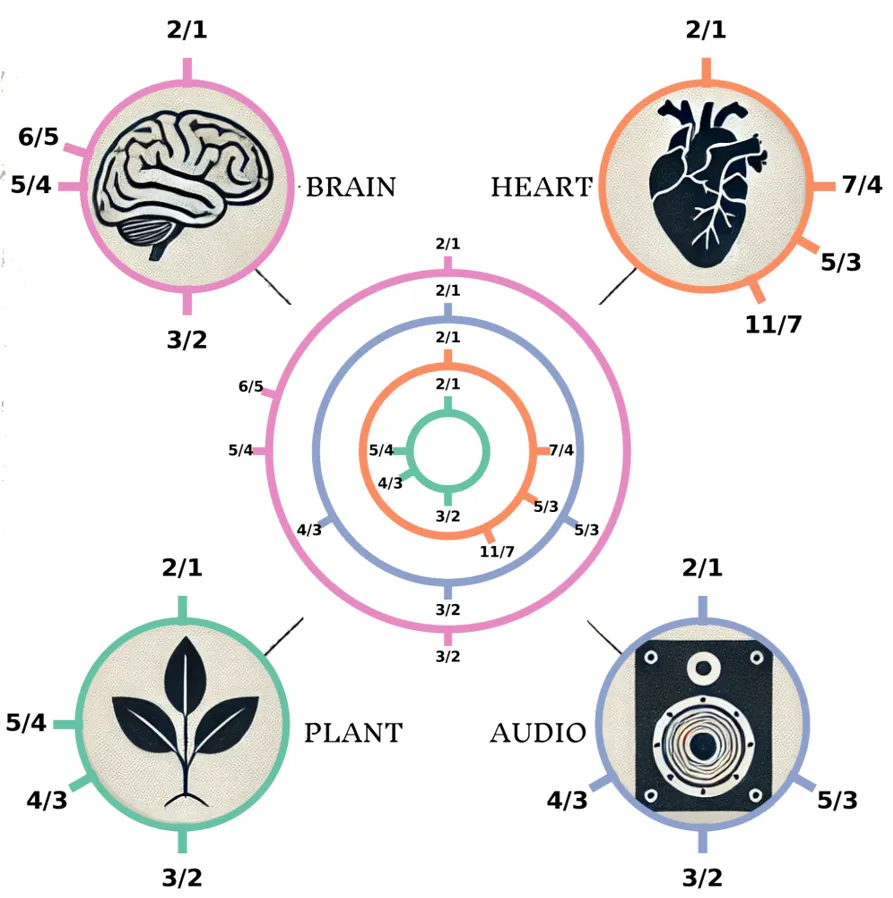
The Biotuner Toolbox is an open-source Python toolbox for biosignals that integrates concepts from neuroscience, music theory, and signal processing. It introduces a harmonic perspective on physiological oscillations by applying musical constructs such as consonance, rhythm, and scale construction. The core biotuner_object processes neural, cardiac, and auditory time series, providing a unified interface for extracting spectral peaks, computing harmonicity metrics, and supporting downstream analyses. Companion modules extend harmonic analyses across temporal (time-resolved harmonicity), spatial (harmonic connectivity), and spectral (harmonic spectrum) dimensions. Biotuner identifies harmonic structure across different biosignals, revealing significant variations in harmonicity between physiological states. The toolbox extracts spectral peaks from complex signals using multiple algorithms, ensuring robust peak detection under varying signal-to-noise ratios. We show how harmonicity metrics change across distinct sleep stages and capture variations in the slopes of the aperiodic (1/f) component of the power spectrum. Biotuner provides an extensible framework that unifies music-theoretic constructs with biosignal processing, enabling hypothesis-driven analyses for researchers and, in parallel, creative exploration of complex natural patterns for artists.
Oneiris: An AI-augmented Brain-Computer Interface for Exploring Personal and Collective Dreamscapes
2025Expanded '25: Conference on Animation and Interactive Art
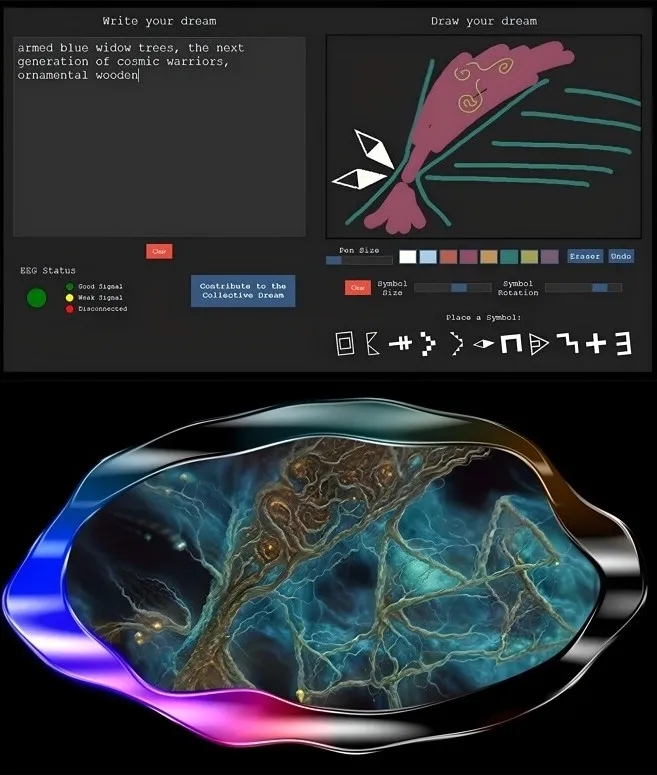
Oneiris is an interactive, AI-augmented brain-computer interface installation that explores personal and collective dreamscapes through generative artificial intelligence, real-time electroencephalography (EEG) neurofeedback, and Indigenous symbolic systems. Participants wear a wireless EEG headset and contribute dream narratives and hand-drawn sketches on a digital tablet. These inputs are embedded using Contrastive Language–Image Pre-training (CLIP) and matched to ten Lakota dream symbols, displayed as a floating constellation within a 360° projection space. A diffusion-based AI pipeline simultaneously augments participants’ sketches and texts into continuously evolving “dreamscapes”, whose texture and color palette are modulated in real time by neural markers of hypnagogia and brain complexity. A Medicine Wheel–inspired interface—an Indigenous symbol embodying the cyclical nature of life—provides viewers with intuitive feedback about their cognitive state as they watch the visuals unfold. In parallel, an online companion platform archives dream contributions as nodes in a collective semantic map, enabling thematic clustering and public exploration. By striving to ethically integrate Indigenous epistemologies—particularly Lakota dream symbolism—into a neuroscientific and generative AI framework, Oneiris provides an innovative model for culturally sensitive, participatory art-science collaboration. The installation offers concrete methodologies for engaging with personal dreams as culturally embedded cognitive phenomena, creating spaces for introspection, collective storytelling, and cross-cultural dialogue.
Bio-Mechanical Poet: An Immersive Audiovisual Playground for Brain Signals and Generative AI
2024International Conference on Computational Creativity
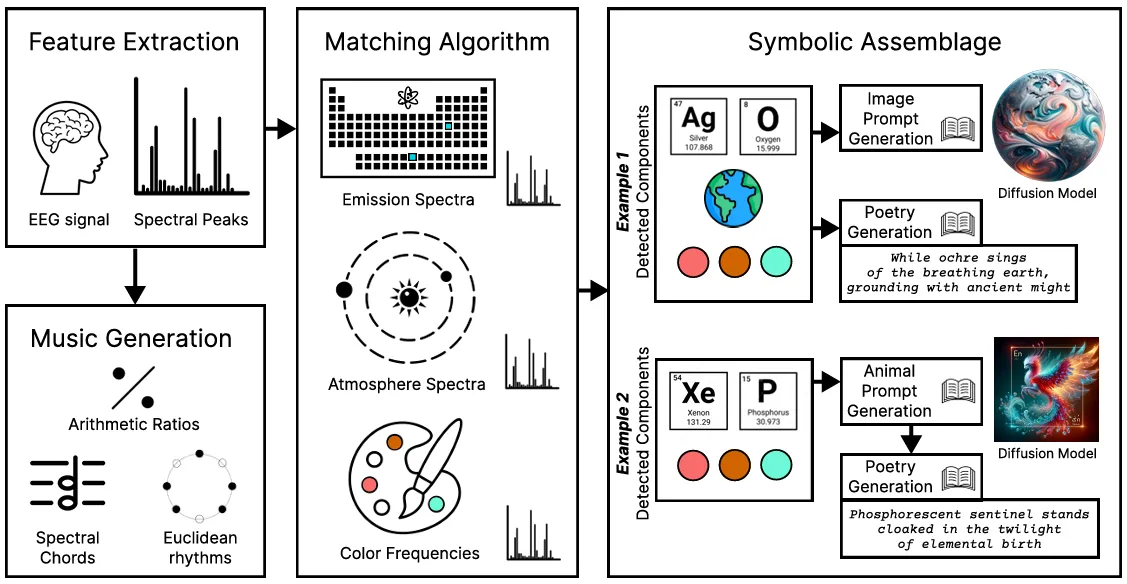
This paper introduces the Bio-Mechanical Poet, an adaptive brain-computer interface that integrates real-time electroencephalography (EEG) data with advanced generative artificial intelligence to create immersive audiovisual poetic experiences. We describe a custom prototyping environment for the exploration of various biosignals and their integration in a multimodal pipeline. By mapping brain states to symbolic representations, we explore trajectories of neural states in a multimodal symbolic latent space. This enables human-interpretable access to it via the modalities of generative music, diffusion-based visuals, and AI-crafted poetry. In doing so, we illustrate how the symbiosis of biosignals and generative systems can provide rich multimodal artworks guiding the user throughout the experience. Our discussion centers on the influence of biofeedback systems integrated with generative AI on evolving storytelling methods and altering perceptual states. We further discuss how translating biosignals into tangible expressions could open new avenues for understanding and interacting with our physiological and subconscious selves. Bio-Mechanical Poet exemplifies the potential of biofeedback and real-time feedback systems to foster advancements in the field of computational creativity, offering insights into the integration of human brain dynamics with artistic creation.
Divergent Creativity in Humans and Large Language Models
2024Scientific Reports
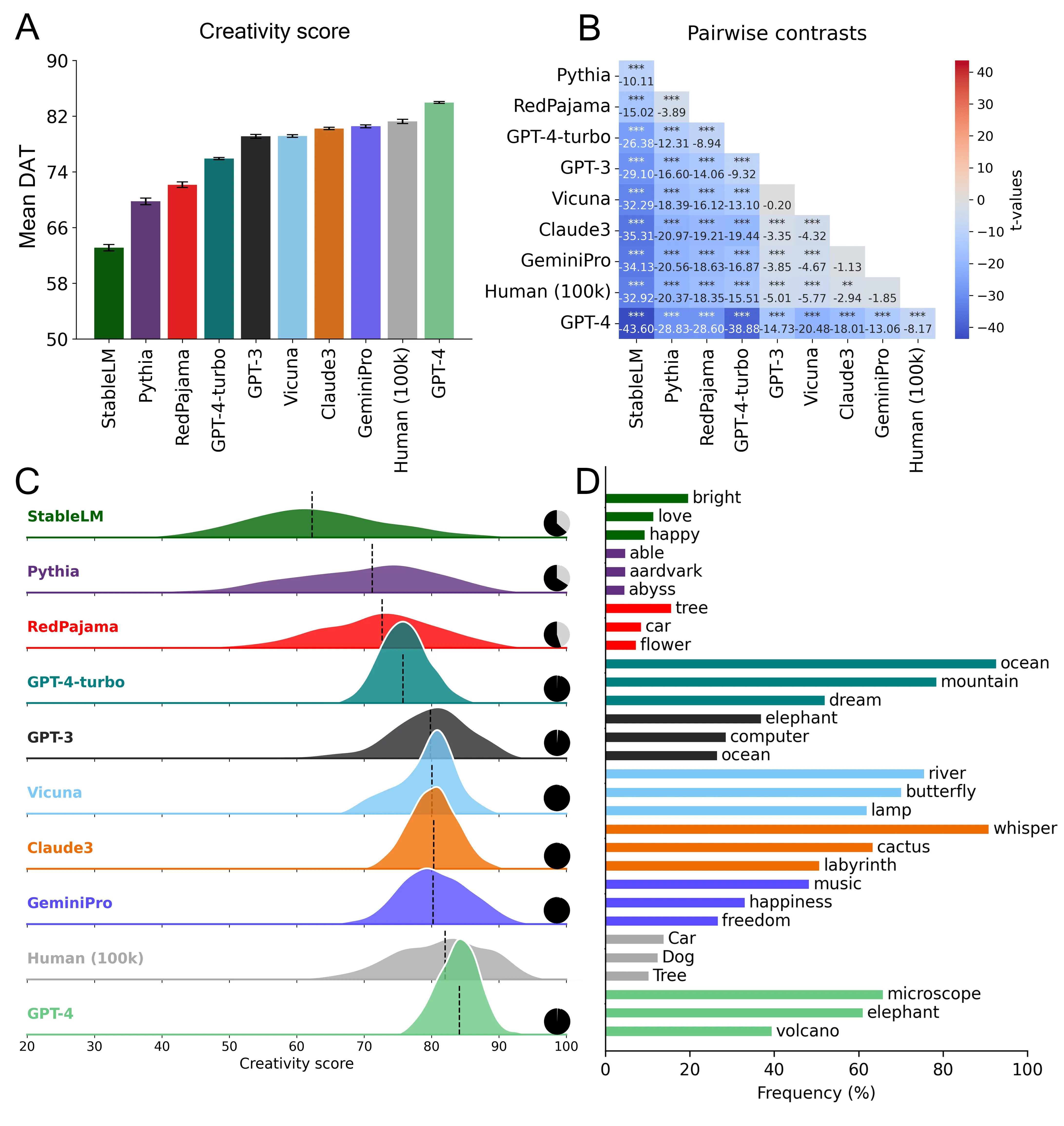
The recent surge of Large Language Models (LLMs) has led to claims that they are approaching a level of creativity akin to human capabilities. This idea has sparked a blend of excitement and apprehension. However, a critical piece that has been missing in this discourse is a systematic evaluation of LLMs’ semantic diversity, particularly in comparison to human divergent thinking. To bridge this gap, we leverage recent advances in computational creativity to analyze semantic divergence in both state-of-the-art LLMs and a substantial dataset of 100,000 humans. We found evidence that LLMs can surpass average human performance on the Divergent Association Task, and approach human creative writing abilities, though they fall short of the typical performance of highly creative humans. Notably, even the top performing LLMs are still largely surpassed by highly creative individuals, underscoring a ceiling that current LLMs still fail to surpass. Our human-machine benchmarking framework addresses the polemic surrounding the imminent replacement of human creative labour by AI, disentangling the quality of the respective creative linguistic outputs using established objective measures. While prompting deeper exploration of the distinctive elements of human inventive thought compared to those of AI systems, we lay out a series of techniques to improve their outputs with respect to semantic diversity, such as prompt design and hyper-parameter tuning.
Divergent Perception: Framing Creative Cognition Through the Lens of Sensory Flexibility
2024Journal of Creative Behavior
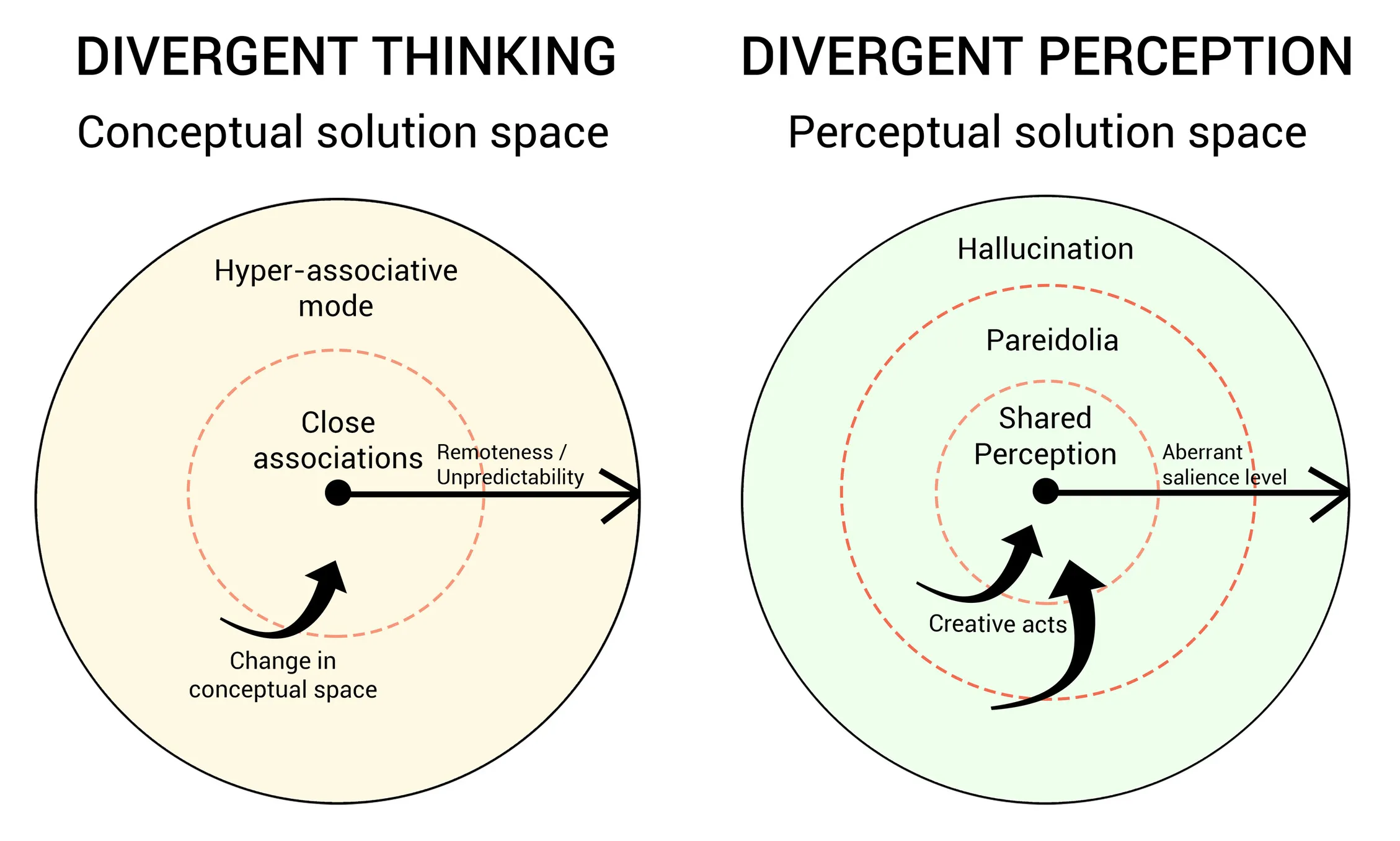
Creativity is a cornerstone of human evolution and is typically defined as the multifaceted ability to produce novel and useful artifacts. Although much research has focused on divergent thinking, growing evidence underscores the importance of perceptual processing in fostering creativity, particularly through perceptual flexibility. The present work aims to offer a framework that relates creativity to perception, showing how sensory affordances, especially in ambiguous stimuli, can contribute to the generation of novel ideas. In doing so, we contextualize the phenomenon of pareidolia, which involves seeing familiar patterns in noisy or ambiguous stimuli, as a key perceptual mechanism of idea generation—one of the central stages of the creative process. We introduce “divergent perception” to describe the process by which individuals actively engage with the perceptual affordances provided by ambiguous sensory information, and illustrate how this concept could account for the heightened creativity observed in psychedelic and psychotic states. Moreover, we explore how divergent perception relates to cognitive mechanisms crucial in creative thinking, particularly focusing on the role of attention. Finally, we discuss future paths for the exploration of divergent perception, including targeted manipulation of stimulus characteristics and the investigation of the intricate interplay between bottom-up and top-down cognitive processes.
Real-Time Neuro-Augmented Cinema via Generative AI
2024NeurIPS Workshop on Creativity & Generative AI
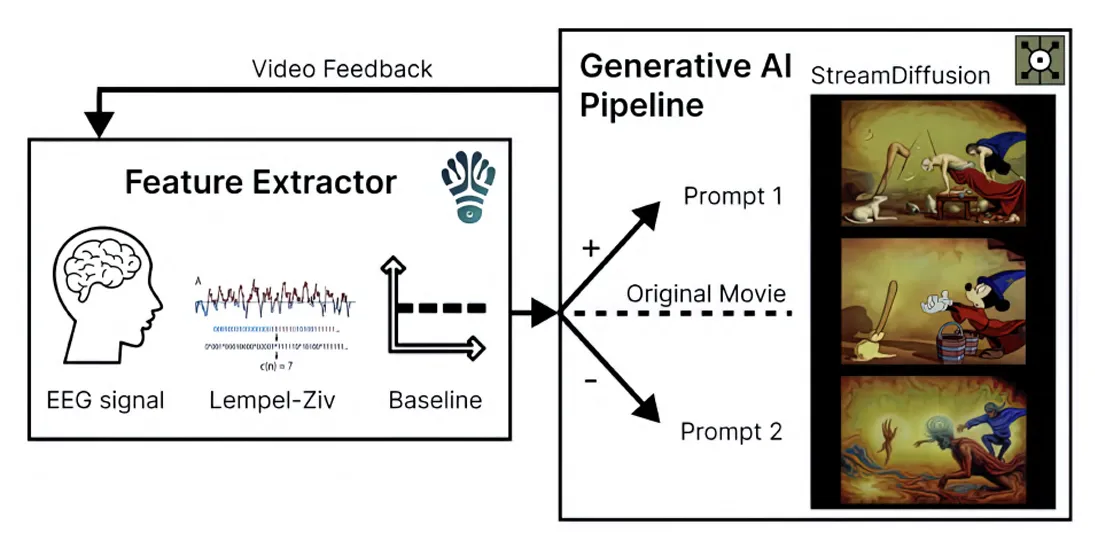
In this paper, we present a novel system that integrates real-time neurofeedback into the creative process of generative AI, enabling seamless interactions between users and AI systems. By leveraging the user’s cognitive variability, the system allows for continuous and fluid co-creation, moving beyond the traditional prompt-based interactions common in generative AI workflows. We achieve this using electroencephalography (EEG) to continuously monitor the user’s brain activity, which then acts as a control signal for a visual generative AI model. We focus specifically on Lempel-Ziv complexity, a measure of signal diversity previously associated with mental states, task engagement, and phenomenological richness. The proposed architecture includes an EEG feature extractor and a generative AI pipeline working in tandem to dynamically alter the visual content of a pre-existing movie based on the user’s brain activity. This approach offers a new dimension of complexity and complicity in the interaction between humans and AI. Future work will explore the integration of more sophisticated bio-signals and multi-modal feedback, aiming to further enhance the depth and richness of the embodied creative experience. This work serves as a proof of principle for integrating biotechnology and generative AI in the emerging field of adaptive cinema.
Processing Visual Ambiguity in Fractal Patterns: Pareidolia as a Sign of Creativity
2022iScience
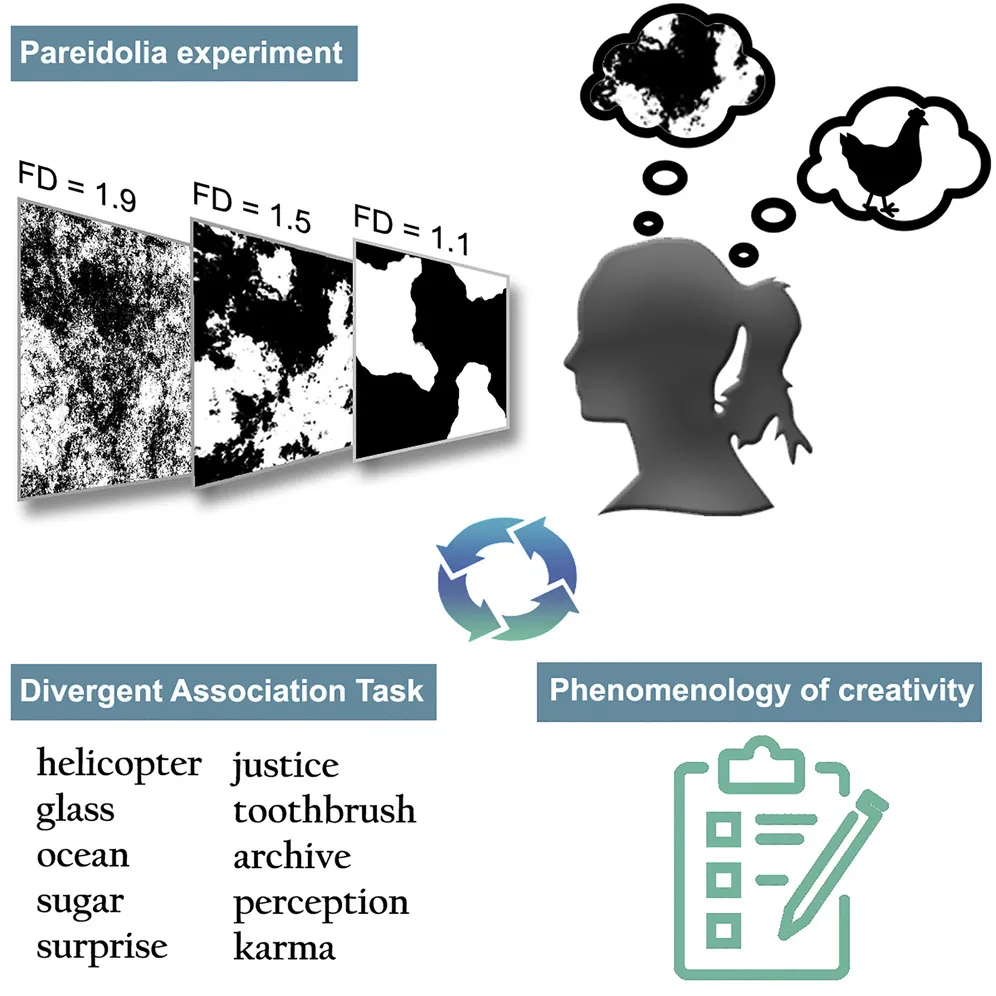
Creativity is a highly valued and beneficial skill that empirical research typically probes using divergent thinking tasks such as problem solving and novel idea generation. Here, in contrast, we examine the perceptual aspect of creativity by asking whether creative individuals are more likely to perceive recognizable forms in ambiguous stimuli—a phenomenon known as pareidolia. To this end, we designed a visual task in which participants were asked to identify as many recognizable forms as possible in cloud-like fractal images. We found that pareidolic perceptions arise more often and more rapidly in highly creative individuals. Furthermore, high-creatives report pareidolia across a broader range of image contrasts and fractal dimensions than do low creatives. These results extend the established body of work on divergent thinking by introducing divergent perception as a complementary manifestation of the creative mind, clarifying the perception–creation link and opening new paths for studying creative behavior in humans.